
Injured in a Motorcycle Accident in Florida?

Motorcycle crashes can cause significant injuries even when symptoms are not immediately apparent. Florida Injury Centers provides physician-led evaluation, documentation, diagnostic coordination, specialist referrals, and ongoing medical oversight after a motorcycle accident.

One Doctor. One Plan. Someone Who Stays With You From Day One.

motorcycle accident in Florida

Motorcycle Accident Injuries Can Be More Serious Than They First Appear

Unlike occupants of cars and trucks, motorcycle riders have very little protection during a collision. Even at relatively low speeds, a rider may sustain injuries involving multiple areas of the body.

Symptoms may be obvious immediately or may become more noticeable over the hours and days following the accident.

Symptoms After an Accident:

Headache and concussion symptom

Head & concussion symptoms

Wrist and hand injuries

Wrist and hand injuries

Ankle and foot injuries

Ankle and foot injuries

Neurological soft-tissue injury

Soft-tissue injuries

Motorcycle accident shoulder injury

Shoulder injuries

Motorcycle accident neck injury

Neck injuries

Motorcycle accident back injury

Back injuries

Hip injuries

Hip injuries

Motorcycle accident knee injury

Knee injuries

Following a motorcycle collision, the presence of these symptoms does not inherently establish a diagnosis of a Motorcycle Accident Injury. A formal medical evaluation by a board-certified physician is necessary to evaluate your condition and determine appropriate next steps.


Common Injuries We Evaluate:

Concussion & head injury

Shoulder & wrist fractures

Knee & Ankle injuries

Cervical & spine injuries

Traumatic brain injuries

Wrist & hand fractures

Neck injuries

Back injuries

Herniated discs

Elbow injuries

Hip injuries

Soft-tissue injuries

Why Early Medical Evaluation Matters After a Motorcycle Crash

A physician evaluation helps document the circumstances of the crash, symptoms, examination findings, injured body regions, medical recommendations, and appropriate follow-up.

Accident occurs

Symptoms may be immediate or initially masked.

Symptoms may evolve

Headache, dizziness, nausea, concentration difficulty, sleep changes and other symptoms may become more noticeable.

Persistent or worsening symptoms deserve evaluation

A physician can determine whether additional testing, treatment or specialist evaluation is appropriate.

Physician evaluation

Neurological screening when medically appropriate

Imaging recommendations when medically indicated

Medication management

Specialist referrals when indicated

Documentation of all symptomatic body regions

Ongoing physician follow-up

Coordinated recovery plan

Physician-Led Injury Care After a Motorcycle Accident

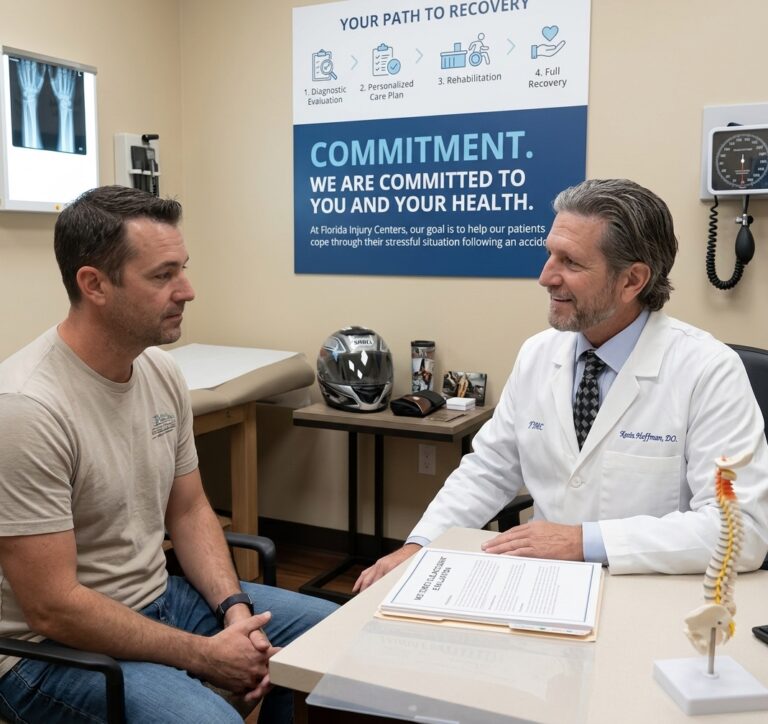
Motorcycle accident injury medical evaluation

1. Motorcycle Accident

Patient is involved in a motorcycle collision.
Physician examining injured patient

2. Physician Evaluation

A medical physician reviews symptoms, medical history, crash mechanism, and examination findings.

Concussion and Injury Screening

3. Diagnostic Testing When Appropriate

Imaging may be recommended based on symptoms and clinical findings.

4. Specialist Referral

Orthopedic, neurological, pain management, chiropractic, physical therapy, or other specialty care may be coordinated when appropriate.

5. Follow-Up

The physician continues to review symptoms, testing, specialist recommendations, and progress.

6. Medical Documentation

The patient's injury-related medical record is maintained throughout the recovery process.

One Accident Can Cause Injuries in Several Areas of the Body

Motorcycle crashes can involve direct impact, twisting, compression, or contact with the roadway. For that reason, a thorough medical evaluation should consider all areas where the patient reports new symptoms following the accident.

Dizziness

Head

Cervical spine

Cervical spine

Thoracic spine

Thoracic spine

Lumbar spine

Lumbar spine

Shoulder

Shoulder

Arm / elbow

Arm / elbow

Wrist / hand

Wrist / hand

Hip-pain

Hip

Knee

Ankle / foot

Ankle / foot

Head Injury and Concussion Symptoms After a Motorcycle Accident

A rider does not necessarily need to lose consciousness to experience concussion-related symptoms after a crash.

Headache and concussion symptom

Headache

Dizziness

Dizziness

Nausea

Nausea

Difficulty concentrating

Difficulty concentrat-ing

Feeling mentally “foggy”

Feeling mentally “foggy”

Light or noise sensitivity

Light or noise sensitivity

Memory problems

Memory changes

Sleep disturbance

Sleep disturbance

Motorcycle accident knee injury

Balance problems

Changes in mood or behavior

Changes in mood or behavior

Because motorcycle impacts can cause complex injuries, these symptoms don't automatically mean you have a concussion or traumatic brain injury. Please consult a medical professional for a proper evaluation to decide if additional diagnostic testing is required.

Some Symptoms Require Immediate Emergency Care

Certain symptoms following a head injury can signal a more serious problem and may require immediate emergency evaluation. If you or someone you’re with experiences any of the following, don’t wait for an outpatient appointment.

Loss of consciousness

Repeated vomiting

Seizure

Significant confusion

Difficulty awakening

Slurred speech

Severe or rapidly worsening headache

New weakness or numbness

Severe shortness of breath

Significant chest or abdominal pain

Suspected fracture or major deformity or Uncontrolled bleeding

Rapidly worsening neurological symptoms

If you believe you may have a medical emergency, call 911 or seek immediate emergency care.

Diagnostic Testing and Specialist Referrals When Appropriate

Not every motorcycle accident patient requires the same testing or treatment. Imaging and specialist referrals should be based on the patient’s symptoms, examination findings, history, and clinical needs.

Imaging When Indicated

MRI, X-ray, CT, or other diagnostic studies may be recommended when medically appropriate.

Specialist Referral

Orthopedic, neurological, pain management, or other specialty consultations may be coordinated when appropriate.

Therapy and Rehabilitation

Physical therapy or chiropractic care may be incorporated into the patient's treatment plan when clinically appropriate.

A note on imaging:

An MRI isn't necessary after every motorcycle accident, and imaging alone doesn't tell the whole story. Diagnostic decisions should be based on a physician's clinical evaluation, including the patient's history, symptoms, examination findings, and clinical needs. Imaging may then be ordered selectively when medically appropriate.

One Doctor. One Plan. Ongoing Medical Oversight.

Florida Injury Centers helps coordinate the injury-related portion of the patient’s care throughout recovery.

We aim to provide consistent physician guidance throughout the patient’s injury care and recovery.

Clear Medical Documentation Throughout Recovery

Detailed medical documentation following a motorcycle accident does more than track paperwork—it gives the physician a complete picture of your healing, highlights emerging symptoms, and guides smart care decisions throughout your recovery.

Complete Medical Record

Symptoms, examination findings, treatment recommendations, and follow-up are documented throughout care.

Consistent Follow-Up

Ongoing physician evaluation helps track progress and identify changes in symptoms.

Coordination With Your Care Team

Records and medical information may be shared with authorized providers and other parties when the patient provides appropriate authorization.

Already Working With an Attorney?

Many injured patients already have legal representation. With the patient's authorization, Florida Injury Centers can provide appropriate medical records and updates directly to the patient's attorney or case manager.
Our role is medical care and medical documentation. We do not provide legal services.

What to Do After a Motorcycle Accident

“What to Know About Concussion Symptoms After a Motorcycle Accident”

In this short video, Dr. Kevin Huffman explains why early medical evaluation matters after a motorcycle crash and how Florida Injury Centers helps coordinate injury care throughout recovery.

How Florida Injury Centers Helps

Board-Certified Medical Physician

Statewide Florida Network

Telemedicine when clinically appropriate

24/7 physician access

Coordination of imaging and specialists when appropriate

Medication management when medically appropriate

Ongoing physician follow-up

Medical documentation throughout recovery

Don't Ignore New Symptoms After a Motorcycle Accident

Early evaluation by a medical physician can help identify injuries, coordinate appropriate treatment, and create a clear recovery plan after a motorcycle crash.

One Doctor. One Plan. Someone Who Stays With You From Day One.

Florida’s Medical Home for Injury Care

FREQUENTLY ASKED QUESTIONS

What injuries are common after a motorcycle accident?

Motorcycle accidents can result in a wide range of injuries, including neck and back injuries, fractures, shoulder and knee injuries, soft-tissue injuries, and head injuries such as concussion or other traumatic brain injury. The type and severity of injury can vary considerably depending on how the crash occurred. A medical evaluation can help determine which symptoms and findings require further attention.

It can be a good idea to seek medical evaluation even if you initially feel okay. Some accident-related symptoms may not be immediately noticeable and can develop or become more apparent later. A physician can review how the accident occurred, assess your symptoms and physical findings, and determine whether follow-up care is appropriate.

Yes. Some injury symptoms may appear hours or even days after an accident. Headache, dizziness, neck or back pain, difficulty concentrating, sleep changes, and other symptoms may develop or become more noticeable over time. Delayed symptoms do not automatically establish a specific diagnosis, but new or worsening symptoms after a crash should be discussed with a healthcare professional.

Not losing consciousness does not by itself rule out a concussion or other head injury. Concussions can occur without loss of consciousness. If you experienced a head impact or significant jolt and subsequently develop symptoms such as headache, dizziness, memory or concentration problems, nausea, balance problems, or unusual behavior, a medical evaluation may be appropriate.

No. An MRI is not automatically necessary for every motorcycle accident or suspected concussion. The need for imaging depends on the patient’s history, symptoms, physical examination, and other clinical considerations. In fact, clinical guidance indicates that routine imaging is not appropriate for every mild traumatic brain injury evaluation. If imaging is medically appropriate, Florida Injury Centers can help coordinate testing as part of the patient’s overall care.

Yes. Depending on the patient’s symptoms and examination, Florida Injury Centers can help coordinate appropriate follow-up care, which may include orthopedic, neurological, pain-management, physical therapy, chiropractic, or other specialist services. The goal is to match the patient with appropriate care rather than sending every patient through the same treatment pathway.

In many situations, yes. Florida Injury Centers provides telemedicine consultations with medical physicians and states that these services are available 24/7 throughout Florida. A telemedicine evaluation can be a convenient way to discuss the accident, review symptoms, document the initial condition, and determine appropriate next steps. However, telemedicine is not a substitute for emergency evaluation when serious or rapidly worsening symptoms are present.

Florida Injury Centers states that its physician-led telemedicine services are available throughout the state of Florida, with access to a network of local healthcare providers. Depending on the patient’s needs and location, care may include coordination with local physicians, chiropractors, physical therapists, orthopedic providers, pain specialists, or other appropriate professionals.

You can still seek care through Florida Injury Centers. With appropriate authorization, Florida Injury Centers can communicate with your attorney and provide relevant medical documentation while coordinating your injury care. Having an attorney does not replace the need for appropriate medical evaluation and treatment.

Go to an emergency department or call 911 for signs of a potentially serious or life-threatening injury. After a head injury, emergency warning signs can include a worsening or persistent severe headache, repeated vomiting, increasing confusion or unusual behavior, difficulty staying awake or being awakened, seizures, slurred speech, weakness or numbness, decreased coordination, or loss of consciousness. Severe neck pain, significant weakness, or other concerning symptoms after a motorcycle crash also warrant urgent medical attention.

If you are unsure whether your symptoms require emergency care, it is safer to seek prompt medical advice rather than relying solely on an online symptom description.